Where to Get Well Water Tested Near You: Lab, Drop-Off, and Mail-In Options
/in Uncategorized/by creatifIf you are searching for well water testing near me, the best place to start is a certified drinking water laboratory. A lab can test your private well water for contaminants that may not be visible, tasted, or smelled, including bacteria, nitrates, arsenic, radon, metals, and other water quality concerns.
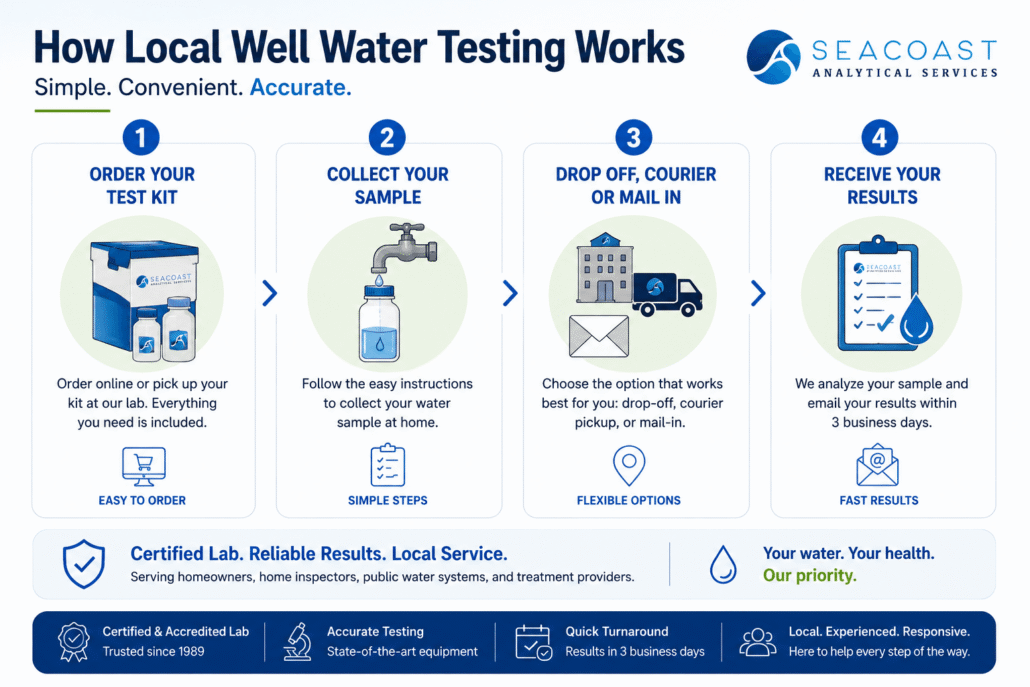
For homeowners in New Hampshire and nearby areas, Seacoast Analytical Services offers several ways to make testing easier. You can order a water test kit, collect your sample using the included instructions, then drop it off, use courier pickup, or mail it to the lab. Seacoast Analytical’s Lee, NH location also offers 24/7 water kit pickup and sample drop-off, with in-house results emailed within three business days for applicable testing.
Whether you are a homeowner, home inspector, buyer, seller, or treatment provider, local water testing gives you clearer answers about what is in your water and what to do next.
Why Well Water Testing Matters
Private well owners are responsible for testing their own water. Unlike public water systems, private wells are not monitored by a town, city, or public utility on your behalf.
That means your water can look clear and still contain contaminants that require lab testing to detect. Some water quality concerns may cause staining, odor, cloudy water, or unusual taste. Others may have no obvious sign at all.
The CDC recommends testing well water at least once a year for total coliform bacteria, nitrates, total dissolved solids, and pH. It also recommends using a state-certified laboratory for well water testing.
If you rely on a private well for drinking, cooking, baby formula, pets, or household use, regular testing gives you information you can act on.
Where to Get Well Water Tested Near Me
If you are wondering where to get well water tested near me, there are three practical options:
- Use a local certified drinking water lab
- Pick up or order a water test kit
- Submit your sample by drop-off, courier, or mail-in service
The right option depends on your location, timeline, and the type of testing you need.
Seacoast Analytical Services works with homeowners, home inspectors, public water systems, and treatment providers. The lab has been analyzing drinking water since 1989 and offers water analysis, radon water testing, radon air testing, and arsenic monitoring.
If you need help deciding what to test for, start with Seacoast Analytical’s water analysis services or contact the team before collecting your sample.
Option 1: Visit a Local Well Water Testing Lab
A local laboratory is often the best choice when you want dependable results and clear testing instructions.
A well water testing lab near me can help with:
- Private well water testing
- Drinking water analysis
- Radon in water testing
- Bacteria testing
- Arsenic testing and monitoring
- Water testing for home inspections
- Follow-up testing after treatment installation
- Local guidance based on regional water concerns
Seacoast Analytical’s main location is in Lee, New Hampshire, where customers can pick up kits and drop off samples at 72 Pinkham Road. The location supports 24-hour pickup and drop-off access for test kits and samples.
This is helpful if you need testing done quickly, are working around a real estate deadline, or want a direct local lab instead of relying on a generic store-bought test.
Option 2: Order a Well Water Test Kit
A water test kit is one of the easiest ways to start local well water testing.
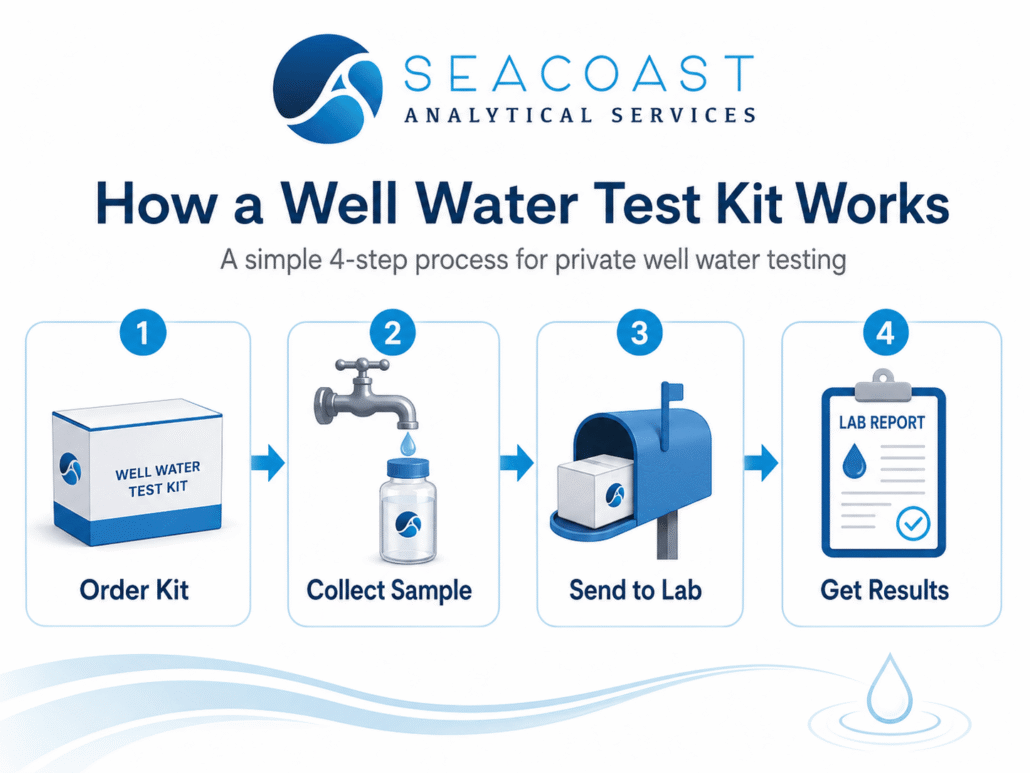
With Seacoast Analytical, the process is simple:
- Pick up or order your kit
- Follow the guide included with the kit
- Mail in or drop off your water sample
You can order your test kit online, pick one up at the Lee, NH location, or prepare ahead by reviewing the water sample guide linked on the order kit page.
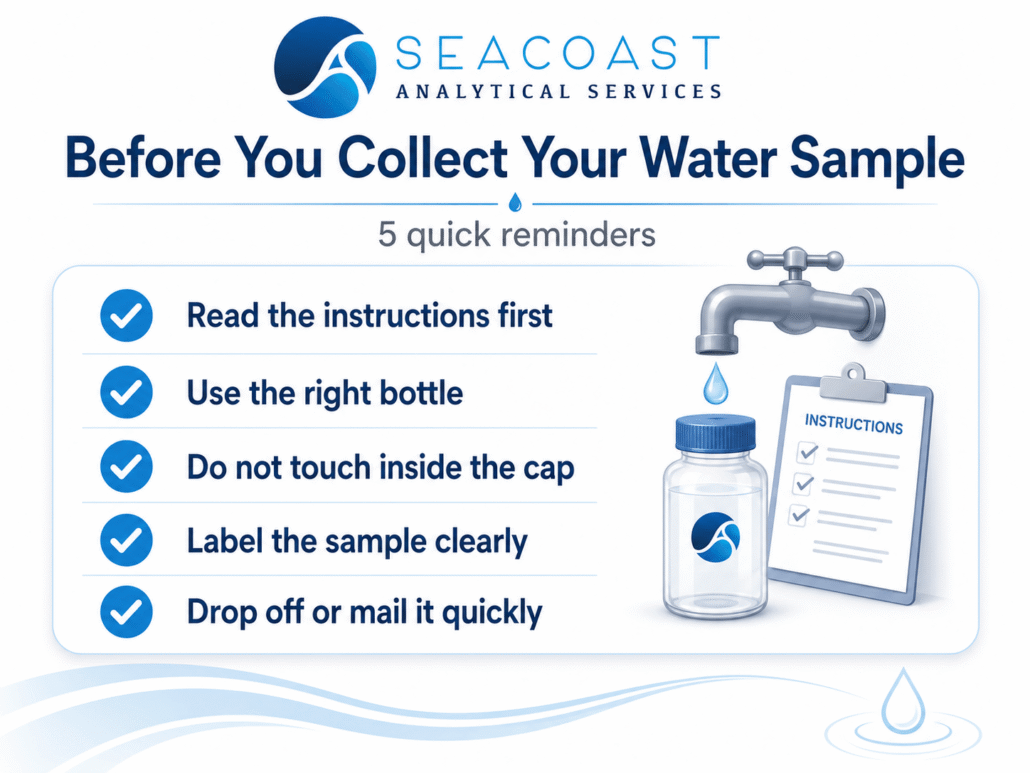
A test kit is useful because it gives you the correct bottles and instructions for the type of water analysis you need. That matters because some samples require specific containers, handling, and timing. For example, a bacteria sample may have different requirements than a radon water sample or a broader mineral analysis.
Do not collect your sample in a random household container. Use the bottles provided by the lab and follow the instructions exactly.
Option 3: Drop Off Your Water Sample
Sample drop-off is a strong option if you live close to the lab or one of the lab’s approved drop-off points.
Seacoast Analytical accepts sample drop-offs at its Lee, NH location 24/7. The company also lists other drop-off locations, including Epping Well & Pump in Epping, NH, North Hampton Animal Hospital, and several additional New Hampshire locations.
You can review the latest sample drop-off and courier service options before collecting your sample.
Drop-off is often the best choice when:
- The sample has a short holding time
- You need results quickly
- You want to avoid shipping delays
- You are testing for a home sale or inspection
- You have multiple samples to submit
- You are coordinating testing for a client or property
Before heading to a drop-off location, check the page details and timing. Some locations may have limited hours, while the Lee, NH location offers 24/7 drop-off access.
Option 4: Use Courier Pickup
Courier pickup may be the better fit if you need a more convenient way to submit samples.
Seacoast Analytical offers courier pickup options by calling 603-868-1457 or emailing CustomerService@seacoastanalytical.com.
This can be especially helpful for:
- Home inspectors managing several properties
- Treatment providers collecting regular samples
- Public water systems
- Customers with repeat testing needs
- Busy homeowners who cannot visit the lab
- Samples that need to arrive within a certain timeframe
Courier pickup removes one of the biggest barriers to water testing: getting the sample to the lab properly and on time.
Option 5: Mail In Your Water Sample
Mail-in testing is a useful option if you are not close to a drop-off location.
Seacoast Analytical’s order kit page says samples should be mailed Overnight USPS to the lab’s mailing address. Their courier and drop-off page also notes that customers more than 30 minutes from a drop-off location may request a complimentary one-day UPS shipping label. This service is listed as available throughout Maine, New Hampshire, Massachusetts, and Vermont.
Mail-in testing may be a good fit if:
- You live outside the immediate Seacoast NH area
- You cannot visit during office hours
- You are testing from Maine, Massachusetts, Vermont, or another nearby area
- You want to collect your sample at home and ship it quickly
- You have already ordered a kit and have the correct bottles
The key is timing. Some samples must reach the lab quickly to be valid, so always follow the instructions included with your kit.
How Much Does Water Testing Near Me Cost?
The cost of well water testing depends on what you need tested.
A simple test may cost less than a broader package that includes bacteria, nitrates, metals, radon, arsenic, and other contaminants. If you are searching for water testing near me cost, the price will usually depend on:
- The number of contaminants included
- Whether the sample is for routine testing or a real estate transaction
- Whether radon water testing is included
- Whether arsenic or other metals are included
- Whether additional specialty testing is needed
- Whether the lab performs the test in-house or works with another lab
- Whether you need courier pickup, shipping, or additional sample bottles
Seacoast Analytical’s FAQ page notes that the lab offers a variety of testing package options, a downloadable rate card, and additional testing services for unique requests.
A good rule: do not choose a water test based only on the lowest price. Choose the package that answers the question you actually have.
For example, a homeowner doing annual testing may need a different package than a buyer under contract, a home inspector, or someone monitoring arsenic treatment.
What Should You Test For?
The right test depends on your well, property, location, and reason for testing.
Common private well water tests may include:
- Total coliform bacteria
- E. coli
- Nitrates
- pH
- Total dissolved solids
- Hardness
- Iron
- Manganese
- Lead
- Copper
- Arsenic
- Radon in water
- Sodium
- Uranium or other local concerns
Seacoast Analytical’s FAQ states that anyone drinking or cooking with private well water should test their water. The page also notes that people with water treatment systems should monitor their water to ensure the treatment continues to work properly.
For general testing frequency, Seacoast Analytical’s FAQ references EPA and New Hampshire Department of Environmental Services recommendations for a Basic Test yearly, Standard Analysis every three years, and radon monitoring every three to five years.
If you are unsure what to test for, use the water testing FAQs or contact the lab for guidance before collecting your sample.
When Should You Test Your Well Water?
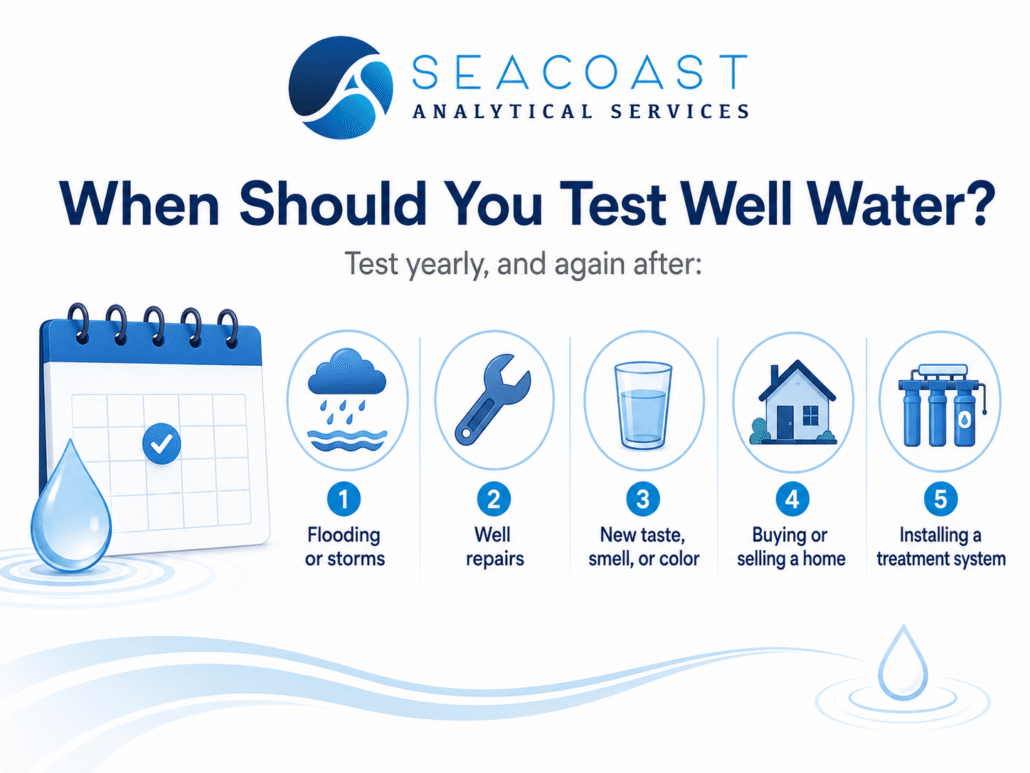
You should test your private well water at least once a year. You should also test sooner when something changes.
Consider testing if:
- Your water has a new taste, smell, or color
- Your water becomes cloudy
- You see staining on fixtures or laundry
- There has been flooding near your well
- Your well or plumbing was recently repaired
- A treatment system was installed or serviced
- You are buying or selling a home
- A baby, older adult, pregnant person, or immunocompromised person lives in the home
- You have not tested your water in several years
- Nearby properties have found contamination
Testing is also useful after treatment installation. A treatment system should not be treated as “set it and forget it.” Ongoing monitoring helps confirm whether the system is still doing its job.
For arsenic concerns, Seacoast Analytical offers an arsenic monitoring program that includes planned sample monitoring, reminders, kits, and reports.
Why Choose a Certified Drinking Water Lab?
A certified lab gives you more reliable information than a basic visual check or general-purpose home strip.
A lab report can help you:
- Understand what is in your water
- Document water quality for a home sale
- Share results with a treatment provider
- Monitor a treatment system
- Decide whether further testing is needed
- Keep records for your household or property
Seacoast Analytical lists several credentials, including the National Radon Safety Board, Vermont Department of Health, New Hampshire Environmental Laboratory Accreditation Program, Maine Laboratory Accreditation Program, and Maine Radon Service Provider certification.
You can review the lab’s credentials on the certifications page.
Local Well Water Testing for Homeowners, Inspectors, and Treatment Providers
Different customers need water testing for different reasons.
Homeowners
Homeowners usually need water testing for annual safety checks, new symptoms in the water, treatment monitoring, or peace of mind. If you drink or cook with private well water, routine testing should be part of home maintenance.
Home Buyers and Sellers
Real estate transactions often come with deadlines. Buyers may want to know the condition of the water before closing. Sellers may want to prepare documentation before listing. Home inspectors may need a dependable lab partner that can process samples correctly.
Treatment Providers
Treatment providers may need water testing before recommending equipment and again after installation to confirm whether treatment is working as intended.
Public Water Systems
Public water systems may require routine monitoring and reliable reporting from an experienced lab.
Seacoast Analytical’s homepage lists homeowners, home inspectors, public water systems, and treatment providers among the groups they work with.
How to Choose the Right Well Water Testing Option
Use this quick guide:
Your Situation | Best Option |
You live near Lee, NH | Pick up a kit and use 24/7 drop-off |
You need testing but are not nearby | Order a kit and use mail-in testing |
You are more than 30 minutes from a drop-off point | Ask about one-day UPS label support |
You are a home inspector or provider | Ask about courier pickup |
You are unsure what to test for | Contact the lab before collecting |
You need annual private well testing | Start with the recommended basic package |
You have a treatment system | Ask about monitoring and follow-up testing |
The easiest first step is to order a test kit or contact Seacoast Analytical for help choosing the right testing package.
Get Local Well Water Testing with Seacoast Analytical
If you are searching for well water testing near me, you do not have to guess where to start.
Seacoast Analytical Services makes private well water testing more convenient with test kits, 24/7 drop-off in Lee, NH, additional drop-off locations, courier pickup options, and mail-in sample support.
Start by choosing the option that works best for you:
- Order your test kit
- View drop-off and courier services
- Explore water testing services
- Contact Seacoast Analytical for help choosing the right package
Your water may look fine. Testing tells you what is actually in it.
FAQs About Well Water Testing Near You
Where can I get my well water tested near me?
Look for a certified drinking water laboratory that offers private well water testing. If you are in New Hampshire or nearby areas, Seacoast Analytical offers local drop-off, courier pickup, mail-in testing, and online test kit ordering.
Can I collect a water sample myself?
Yes. Most homeowners can collect their own sample using the bottles and instructions provided by the lab. Seacoast Analytical includes instructions with its kits and also provides downloadable water sample guides through its order kit and FAQ pages.
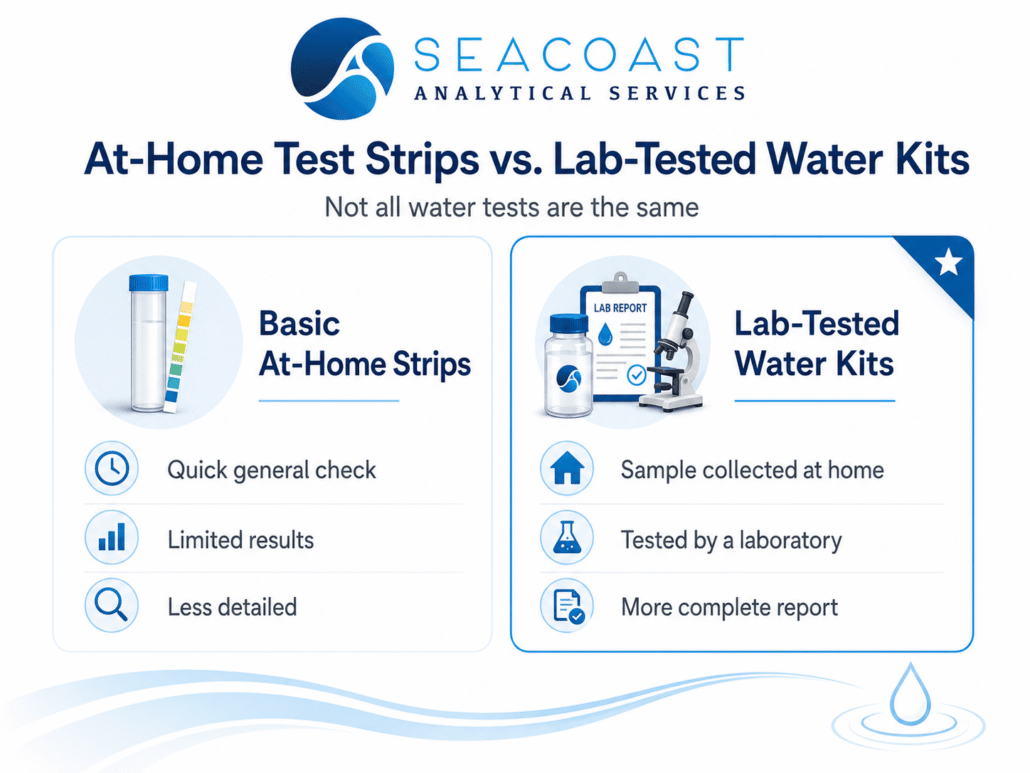
Is a home water test kit the same as lab testing?
Not always. Some store-bought kits use strips or simple color changes. A lab test kit allows you to collect the sample at home, but the actual analysis is completed by a laboratory.
How long do well water test results take?
Seacoast Analytical’s FAQ says test results are emailed within three business days for all in-house analysis. Hard copies may also be mailed upon client request.
How often should I test my private well water?
At minimum, test your private well water once a year for common water quality indicators. Seacoast Analytical’s FAQ also references yearly Basic Testing, Standard Analysis every three years, and radon monitoring every three to five years.
Can I mail in my water sample?
Yes. Seacoast Analytical accepts mail-in samples and provides mailing instructions on its order kit page. Customers farther from drop-off locations may also contact the lab about one-day UPS shipping label support.
What if my test shows a problem?
Your lab report can be shared with a qualified water treatment professional. Seacoast Analytical’s FAQ notes that they are an analyzing lab, not treatment professionals, and recommends taking the report to a treatment professional for treatment questions.